

A guide to matcha, and what ceremonial grade really means
Almost everything on the packet is unregulated, unverified, or quietly backwards. Here is the sourced version.
Almost everything you have read about matcha on a packet is either unregulated, unverified, or quietly backwards. This is an attempt to write the honest version — what matcha actually is, what the grades really mean, and which of the health claims survive contact with the evidence.
We serve a lot of it, so we have an interest in you buying some. That is exactly why the claims below are sourced and the ones we could not source are left out.
What matcha is, precisely
There is an international standard for this — ISO/TR 21380, published in 2022 and developed by Japan’s national agriculture research organisation. It defines matcha as tea from Camellia sinensis var. sinensis, grown under shade, steamed to deactivate its enzymes, dried without rolling the leaves, and finely ground into powder.
Three things follow from that definition, and only the third is unique to matcha:
- It is shade-grown — which it shares with gyokuro and kabusecha.
- It is not rolled — sencha and gyokuro are. This is the real processing divergence, and the unrolled dried leaf has its own name: tencha.
- You drink the leaf, not an infusion. Every other tea is water that has passed through leaves and left them behind. Matcha is a suspension of the leaf itself.
That last point is the whole thing. It is why matcha tastes the way it does, why it has to be whisked rather than steeped, and why it is the only tea where the grind matters.
The shade, and what it actually does
The plants are covered for roughly two to four weeks before harvest — the ISO document describes shading at 70–80% light blockage rising to 95–98%, with picking at twenty to thirty days. Reed screens traditionally; synthetic fabric now.
Here is where most explanations go slightly wrong. You will read that shading makes the plant produce more theanine. The better-evidenced version is subtler: shading suppresses the conversion of amino acids into catechins. A 2018 study in BMC Plant Biology found that fourteen days of shading cut major catechins by more than half. So the amino-acid-to-catechin ratio rises — which is what you taste as sweetness and umami instead of astringency.
The grind
ISO specifies particles of ten to thirty micrometres, with a median below twenty. That is finer than icing sugar and it is why matcha suspends in water at all rather than sinking. Stone mills are used for high-quality matcha — though note that Japan’s own labelling standard says a tea mill “or equivalent”, so stone grinding is convention, not law.
“Ceremonial grade” is a marketing term
This is the single most useful thing in this article, so we will be blunt about it.
There is no such grade. ISO/TR 21380 contains no grade classification at all. Japan’s own green tea labelling standard defines matcha and tencha and establishes no ceremonial-versus-culinary distinction. Zach Mangan, who founded the specialist importer Kettl and has written a book on the subject, puts it flatly: in Japan there is no agreed classification for matcha. None. In Japan, matcha is sold under producer and blend names, the way wine is sold under an estate name rather than a tier.
“Ceremonial grade” is a Western retail label that grew into a regulatory vacuum. Its origin is not documented — the earliest trace anyone has found is a rise in searches around 2004.
Now the part that should genuinely change how you shop. A 2025 peer-reviewed comparison in the Journal of Food Measurement and Characterization measured culinary and ceremonial matcha side by side. Ceremonial came out higher in caffeine and chlorophyll — consistent with younger, more heavily shaded leaf. But culinary grade measured higher in total phenolics, total flavonoids and antioxidant capacity.
So the common claim that ceremonial grade is the healthier one runs backwards from the data. Ceremonial grade is a flavour and colour proposition. That is a perfectly good reason to pay for it — it is the reason we do — but it is not a nutritional one.
(The study’s limits, since we are being honest: five products per group, bought online, with the authors accepting the vendors’ grade labels. Given that the term is unregulated, that is a real weakness. Treat it as one good study, not a settled fact.)
So what does make matcha good?
Origin, cultivar, how long it was shaded, whether it was hand or machine harvested, how it was finished and blended, how long it rested, and how it has been stored since. And above all how recently it was ground — matcha oxidises, and old matcha goes dull in colour and flat in taste.
Colour is a reasonable proxy, because chlorophyll tracks shading intensity and shading is what produces the flavour profile. But it is only a proxy. Vivid green does not guarantee quality, and as the study above shows, it does not track antioxidants at all.
Where it came from
Powdered green tea reached Japan from China in the twelfth century, carried back by Buddhist priests who had gone to study religious texts. The Rinzai Zen priest Eisai (1141–1215) is credited with bringing the practice of drinking tea in powdered form. It took hold in monastic life for a practical reason: it helped monks stay alert through long meditation.
The Chinese method being imported was Song-dynasty — leaves ground to powder and whisked. China later abandoned it for steeped leaf tea. Japan did not.
What became chanoyu, the tea ceremony, was shaped by three men: Murata Shukō (1422–1502), who formalised the practice along Zen lines; Takeno Jō-ō (1503–1555); and Sen no Rikyū (1521–1591), who established the form still practised today. Rikyū's four principles were harmony, respect, purity and tranquility, and the phrase most associated with him is ichi-go ichi-e — one time, one meeting. The gathering you are at will not happen again in this exact form.
The shading technique that makes tencha was developed by Japanese farmers in the sixteenth century.
One correction about Uji
Uji in Kyoto and Nishio in Aichi are the historically prestigious regions, and you will see both on packaging. But Japan’s agriculture ministry data for 2023 shows Kagoshima now produces more tencha than Kyoto — 1,585 tonnes against 970, thirty-eight per cent of national production against twenty-three. Uji’s standing is historical and reputational. It is not volumetric, and origin alone is not a quality guarantee.
How it is actually prepared
Two traditional preparations, and the difference between them is concentration.
Usucha, thin tea, is what almost everyone drinks: about two grams of matcha to sixty millilitres of water, whisked vigorously for around fifteen seconds. Koicha, thick tea, is four grams to thirty millilitres — roughly four times the concentration — and is mixed slowly rather than whisked, because you are not trying to aerate it. It comes out closer to paint than to tea, and it is unforgiving: any astringency in the leaf is exposed.
Water at around 80°C. You will see 70 and you will see 90; it is a house preference, not a rule. The chemistry underneath is real, though — hotter water pulls more catechins, which is more astringency.
Why sifting matters
Matcha clumps. Those ten-to-thirty-micrometre particles are hygroscopic and hold a static charge, so they aggregate into lumps that whisking alone will not fully break. Sift first and you get a smooth suspension; skip it and you get a gritty one with a skin of dry powder on top. Every serious source instructs sifting. We do it for every cup, which is part of why a matcha here takes a moment longer than you might expect.
Why a whisk and not a spoon
Because matcha is a suspension, not a solution. Nothing dissolves. The job is to disperse insoluble leaf solids evenly through water and aerate the top, and a chasen — a whisk carved from a single piece of bamboo, usually eighty or a hundred prongs — does that in a rapid W motion in a way a spoon cannot. Koicha is the exception: it is deliberately not aerated.
What it tastes like, and why
Good matcha leads with umami — savoury, almost broth-like, with a sweetness behind it — and finishes clean. That comes from theanine, the dominant free amino acid in tea. A measured two-gram serving contains about forty-eight milligrams of theanine, sixty-six of caffeine and a hundred and seventy of catechins.
Astringency is the drying, mouth-puckering sensation, and it has a specific mechanism: polyphenols bind to proteins in your saliva and form a film. EGCG is the main culprit in green tea. What is genuinely interesting is that theanine and caffeine both suppress it — a 2024 paper in Foods found theanine reduces the interaction between EGCG and salivary proteins, and caffeine forms hydrogen-bonded complexes with catechins that stop them binding at all.
Which gives a real explanation for good versus poor matcha rather than a matter of opinion. High theanine relative to catechins — younger leaf, longer shading — means umami dominates and astringency is chemically suppressed. Low theanine and high catechins — later harvest, less shading, more mature leaf — leaves the astringency unmasked.
One practical note from the same research: hard water increases astringency, because metal cations amplify it.
Caffeine, and the health claims
A two-gram bowl of matcha contains roughly sixty to ninety milligrams of caffeine. A twelve-ounce brewed coffee contains 113 to 247, according to the US Food and Drug Administration. So matcha has less caffeine than coffee per serving, and the widespread claim that it has more comes from comparing dry weights rather than what is in the cup.
Now the part where we disappoint you slightly.
“Calm alertness with no crash” is not an established effect. A 2025 systematic review and meta-analysis in Nutrition Reviews pooled the randomised trials on theanine and caffeine together. It found small but statistically significant improvements in two specific attention measures. It found no statistically significant effect on mood. Findings on sleep were inconclusive. The authors note the confidence intervals frequently highlighted uncertainty about direction and magnitude, and that most trials used isolated compounds at doses not matched to actual tea. We found no evidence base whatsoever for the “no crash” claim.
The antioxidant claims are weaker than you think. A Cochrane review — the highest standard in evidence synthesis — looked at 142 studies covering over 1.1 million participants on green tea and cancer prevention. Every finding was rated low-certainty, and the conclusion was that results were inconsistent and the evidence limited. Cochrane also documented adverse effects at high intakes: gastrointestinal problems and elevated liver enzymes.
The European Food Safety Authority found that EGCG at 800mg a day or more from supplements may be associated with early signs of liver injury — but also that traditional green tea as a drink shows generally no indication of liver damage even at high consumption. A two-gram matcha delivers about 170mg of catechins, comfortably within normal dietary range.
And the most honest single data point: a randomised, double-blind, placebo-controlled trial published in PLOS ONE in 2024 gave two grams of matcha daily to ninety-nine older adults for a full year. Its primary cognitive outcomes were null. No significant change.
You will also see “137 times the antioxidants of green tea”. Do not believe it. It traces back to a single small 2003 analysis using a non-standard method and conflates concentration in dry powder with what you actually ingest. The genuine, defensible version is narrower and still interesting: because you consume the leaf rather than an infusion, you take in compounds that would otherwise stay in a discarded tea bag.
What you can honestly say about matcha: it is a pleasant, moderately caffeinated drink containing catechins and theanine, safe at normal consumption, with a flavour nothing else quite replicates. That is enough. It does not need to cure anything.
Why it is suddenly everywhere
The numbers here are striking. Japan’s tencha production rose from 1,452 tonnes in 2020 to 4,176 tonnes in 2023 — nearly tripling in three years, a record. In the first ten months of 2025 Japan exported 10,084 tonnes of green tea, the first time above ten thousand in seventy-one years, up forty-four per cent year on year. The United States took thirty per cent of it, mostly powdered.
The shortage began in the second half of 2024. Industry sources told CBC that Japanese export volumes had grown 115% over five years, that wholesalers were marking up as much as forty per cent and resellers up to a hundred and fifty, and that it would take one to two years for producers to catch up.
The structural reason is worth understanding: matcha supply is unusually inelastic. Tencha needs shade infrastructure, dedicated kilns and mills, and new tea bushes take years to yield. Many farms are small and family-run. So a demand shock does not produce more matcha — it produces shortage and price rises, which is exactly what has happened.
Eight things people get wrong
- “Ceremonial grade is an official Japanese classification.” It is not. No such tier exists in the ISO standard or Japan’s own labelling standard.
- “Ceremonial grade is healthier.” The one peer-reviewed comparison found the opposite for antioxidant measures.
- “Energy without a crash.” No evidence base.
- “More caffeine than coffee.” Not per serving.
- “137 times the antioxidants.” A misused figure from one small old study.
- “It comes from a special plant.” Same species as sencha, oolong and black tea. The difference is cultivation and processing.
- “All the good matcha is from Uji.” Kagoshima now produces more.
- “Boiling water ruins it.” Overstated. Hotter water means more astringency; it is a preference range, not a rule.
How to drink it here
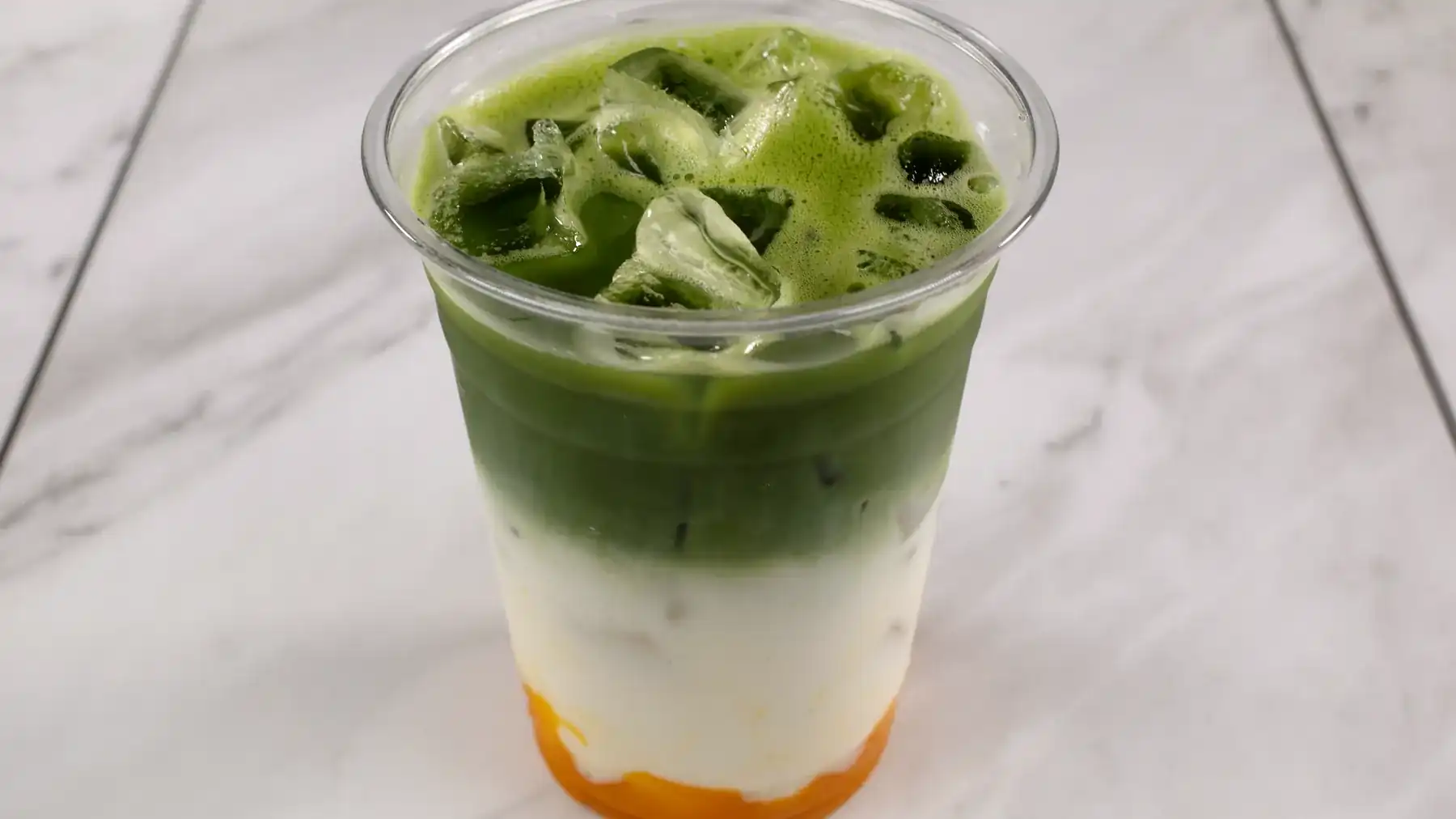
Ours is ceremonial grade, sifted and whisked to order — never mixed in advance. The Matcha Latte is the honest version: matcha, milk, ice, with a hazelnut caramel option. The two Fusions layer it over strawberry or mango purée, poured slowly enough that the layers hold down the glass.
If you have only had matcha as a sweetened powder from a jug, order the plain latte first and give it a moment before you judge it. It should taste savoury before it tastes sweet. If it tastes of nothing but milk and sugar, something upstream went wrong — and now you know exactly where to look.
Read next: our matcha bar · how we make things · the full menu
Written by the team at Knight & Rose Café, 236 Queen Street South, Streetsville, Mississauga.