

What makes Knight & Rose different from a traditional coffee shop
The most useful thing we can tell you is that you have to go upstairs. That single fact explains most of the others.
The most useful thing we can tell you about Knight & Rose is that you have to go upstairs. That single fact explains most of the others.
We are on the second floor of 236 Queen Street South. There is a door at street level between the shopfronts and a flight of stairs behind it, and the room is at the top. You do not walk past us and drift in. You either know we are here or you look up and wonder. Everything about how the place works follows from that: nobody arrives by accident, so the room is built for people who meant to come.
A coffee shop is a transaction. This is a room.
The standard coffee shop is optimised for throughput, and there is nothing wrong with that. Counter at the front, queue along the side, tables sized so that four people can sit but two people will not linger. The economics are volume, and the design tells you so honestly.
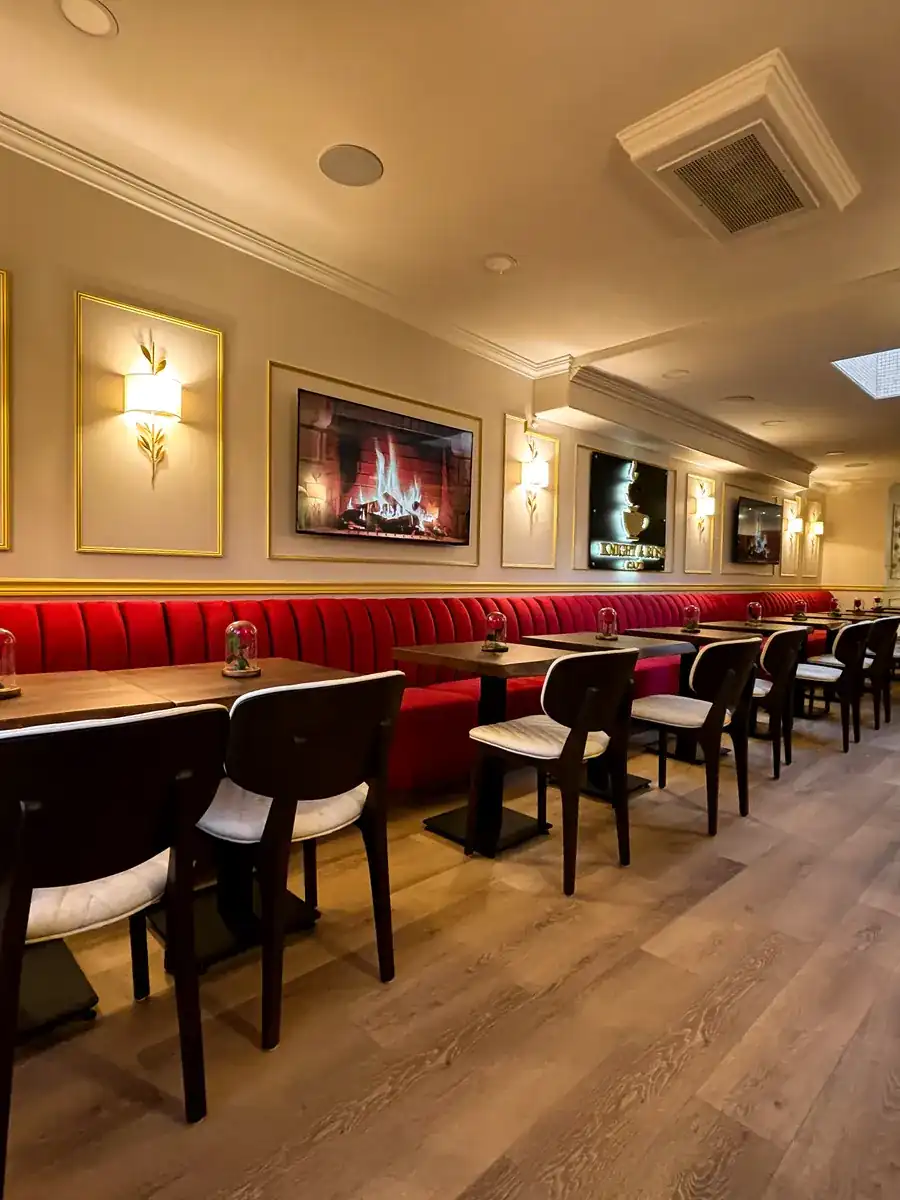
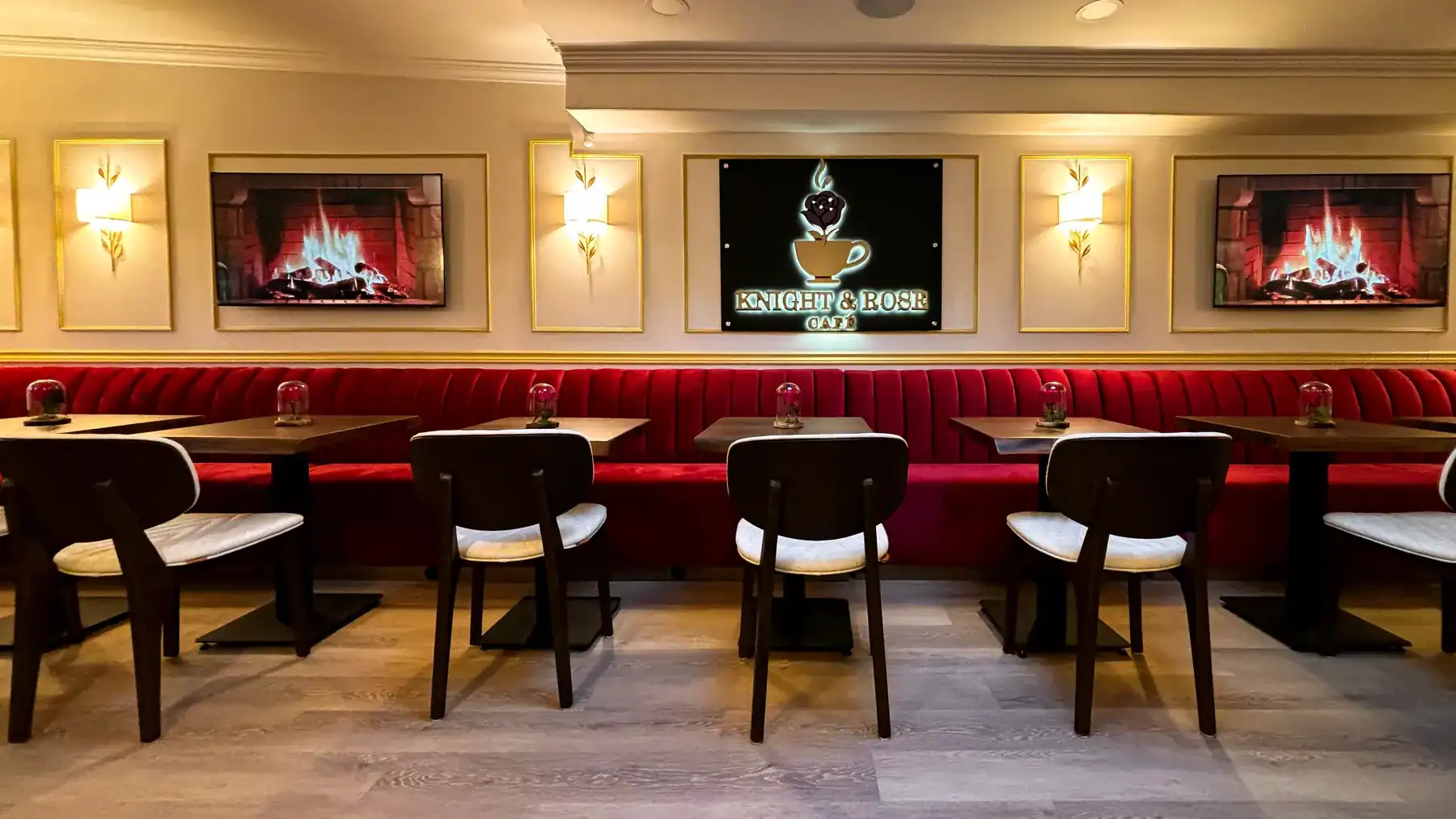
We are optimised for the opposite. The room is one long space with red velvet banquettes down the wall, walnut tables, brass sconces and a preserved rose under glass on every table. Nothing about it says finish your drink. It is the whole upper floor of the building — there is no downstairs trade to serve, no queue forming behind you, no second sitting waiting for your table.
That has a cost, and we should be straight about it: everything takes slightly longer here. Espresso is pulled to order and never held. Milk is steamed by hand for each drink rather than in a batch and topped up. Matcha is whisked at the bar rather than shaken from a jug mixed that morning. Chai is brewed rather than poured from a flask. If you are in a hurry, we are the wrong choice, and we would rather say that than disappoint you.
What we actually make
Coffee
The Rose Silk Latte is the drink people describe when they are trying to explain this place to someone else — rose, espresso and steamed milk, finished with dried petals. It took a year of adjusting the ratio before it went on the board, which sounds like a story until you have tasted a rose latte that got it wrong. The Spanish Latte is what most people order second. The Mocha Emerald layers pistachio cream over chocolate and is the one that gets photographed before it gets drunk.
Behind those sits an ordinary, properly run espresso bar: Espresso Noir, macchiato, americano, and the Ivory Crest Cappuccino with a foam crest, available in caramel, hazelnut, vanilla or rose. The affogato — espresso straight over vanilla ice cream — is the most ordered dessert in the room that is not on the dessert list.
Matcha
Ceremonial-grade, sifted and whisked to order. The Matcha Latte is the plain version, hot or iced. The two Fusions, strawberry and mango, are built cold in layers so the colours hold their line down the glass, which is why they are iced only — you cannot layer a hot drink.
We have written a longer piece on matcha for anyone who wants to know what ceremonial grade does and does not mean. The short version: it is a marketing term rather than a regulated one, and what actually matters is the leaf, the shading and how recently it was ground.
Chai and tea
Five chai, all five dollars, all available hot or iced. The Blush Kashmiri Velvet is the one people come to Streetsville for — pink from slow cooking rather than from colouring, finished with rose. Royal Karak and Karak Cardamom for strength, the short dark properly boiled kind. Masala Heritage for spice. Cardamom Gold sits between them.
Alongside that, eleven loose-leaf teas at four dollars — Earl Grey, Japanese Sencha, Thé Au Jasmin, Vergers Des Ming, Vallée Du Nil, La Chamomile, English Breakfast, Touareg, Sencha Lemon, Green Passion. Add a teapot for four dollars and a drink becomes something to sit over.
Desserts
Made in-house, which is also why they run out. Crème brûlée cracked to order. A chocolate lava cake with a centre that still moves. Lotus tres leches soaked overnight and finished with Biscoff crumb. A Raspberry Bloom set in a rose mould and a glazed Mango Royale. Five of them, and most evenings they are gone before we close.
The materials are the argument
People notice the room before they notice anything on the menu, so it is worth explaining what it is actually made of and why.
Red velvet banquettes down one wall. Velvet is not a decorative choice — it is an acoustic one. Soft surfaces absorb sound, hard ones bounce it. A room with concrete floors and glass walls photographs beautifully and is exhausting to hold a conversation in, because everyone raises their voice to be heard over everyone else raising theirs. Upholstery, wood and fabric break that feedback loop. It is the difference between leaving a place tired and leaving it relaxed, and almost nobody can identify why.
Walnut tables, at dining height rather than café height. Low tables and stools are a throughput decision; you cannot comfortably sit at them for three hours, which is the point of them.
Brass sconces at and below eye level rather than downlights overhead. Overhead light casts shadows downward, which is unflattering on every face that has ever existed. Warm light from the side is the reason people look better here than in their own kitchens.
A preserved rose under glass on every table. Which is a flourish, and we are not going to pretend otherwise. But it is also the thing people photograph, and it is where the name lands.
What we do not do
Worth being straight about, because a place that claims everything is claiming nothing.
We do not do fast. If you need a coffee in four minutes on your way somewhere, there are places on this street that will serve you better than we will, and we would genuinely rather you went to one of them than stood at the top of our stairs feeling impatient.
We do not do a full kitchen. There is a dessert list and there are shakes and refreshers; there is not a dinner menu. People sometimes arrive expecting a restaurant, and it is better to know before you climb.
We are on the second floor, up one flight of stairs, and that will not suit everyone.
The room changes at eight
This is the part that surprises people. Through the afternoon the booths belong to laptops, students and long conversations. Nothing about the room changes at eight except the hour and the light — but the red reads deeper, the brass does more work, and the corner booths that belonged to a laptop at three belong to a couple by nine.
The full menu runs until close: espresso, chai, matcha and dessert, at eleven at night, which is unusual in Mississauga and is the reason people end evenings here rather than starting them. We close at midnight Monday to Thursday and at one in the morning Friday to Sunday.
If you want the evening version of the room, book. Thursday to Sunday fills, and the corner tables go first.
What it gets used for
Four things, mostly, and they do not overlap much.
Working afternoons. The room is quiet before six and the booths are comfortable enough to sit in for three hours. We would rather you ordered twice than felt watched.
Dates. More of these than anything else, and we think the reason is simple: a coffee date has no fixed end, so the venue has to be somewhere neither person minds staying. A room with proper seating and no queue behind you does that.
The gathering that needs a room. Because we occupy the whole second floor, a private booking here is not a corner roped off from a busy restaurant. It is one long space with its own stairway and its own door at street level. Birthdays, engagements, showers, team dinners. Capacity and cost are quoted per enquiry rather than sold as a package, because they depend entirely on how the room is laid out for you — tell us the date and the numbers and we will tell you what it can do.
Somewhere else entirely. The same baristas, machines and menu travel on our mobile café cart — weddings, corporate mornings, launches, across the Greater Toronto Area. Each package covers up to fifty guests over a three-hour minimum and includes two baristas, delivery, set-up and takedown.
Why we are on the second floor
People ask whether we would rather be at street level, and the answer is no.
A street-level café belongs to the street. It gets the passing trade, the person who wanted a coffee three minutes ago, the queue at half past eight. That is a good business and it is not this one.
A room up a flight of stairs belongs to the people who climbed them. It is quieter than the street, it holds an evening better than a shopfront does, and it gives you the one thing a café almost never has: the feeling of having arrived somewhere rather than stopped somewhere.
Streetsville is a village that a city grew around. It has been getting people to slow down for two hundred years. We just put a room at the top of some stairs and let it do the rest.
Read next: the village itself · what ceremonial matcha really means · the full menu
Written by the team at Knight & Rose Café, 236 Queen Street South, Streetsville, Mississauga.