

Planning the perfect coffee date in Mississauga
The hardest easy plan there is. The failure is almost never the two people — it is the room.
A coffee date is the hardest easy plan there is. Dinner has a structure and an ending. A drink has a clear purpose. Coffee has neither, which is exactly why people choose it — and exactly why it so often goes flat about forty minutes in.
The failure is almost never the two people. It is the room.
Why the venue does more work than you think
A first or early date is a conversation held under mild pressure. Anything the room does badly, the two of you have to compensate for.
If the music is loud, you lean in and shout, and shouting kills nuance. If the chairs are hard, your body starts telling you to leave at the forty-minute mark and you mistake that for boredom. If there is a queue forming behind your table, you feel it, and you start wrapping up. If the room is bright and flat, everyone looks tired and no one knows why.
The reverse is also true, and it is worth knowing because it feels like chemistry when it is actually furniture. A room with soft light, seating you can stay in, no queue and no closing time gives a conversation permission to keep going. People walk out of those rooms thinking the conversation was extraordinary. Sometimes it was. Sometimes the room simply did not interrupt it.
Choosing the place: five things that actually matter
1. Can you stay?
The single most important question, and the easiest to check. Look at the seating. Banquettes, armchairs and proper dining chairs say stay. Stools, high tables and bench seating say finish your drink. A café optimised for throughput is not being rude; it is being honest about its economics. But it is the wrong room for a date.
2. Can you hear each other?
Go somewhere with soft surfaces — upholstery, curtains, carpet, wood. Hard rooms with concrete and glass look wonderful in photographs and are exhausting to talk in. If you have to raise your voice to be heard at your own table, you will both be tired within the hour.
3. What is the light doing?
Overhead fluorescent light is the enemy of every face that has ever existed. Look for lamps, sconces, table light — anything at or below eye level. It is not vanity. Warm low light makes people relax, and relaxed people are better company.
4. Does it close in ninety minutes?
Check the hours before you book, not after. There is nothing worse than a conversation that is genuinely working being ended by chairs going up on tables. If a place shuts at six, you have scheduled a ninety-minute date whether you meant to or not.
5. Is there somewhere to go afterwards?
The best coffee dates have an optional second act built in — a walk, a bookshop, a river. Not because you have to use it, but because having somewhere to go next means the date can extend naturally instead of requiring somebody to make a speech about it.
Timing it
Weekday afternoon, two to four. The best-kept secret. Rooms are quiet, staff have time, and there is no weekend crowd. It also has a natural, pressure-free ending in the evening if you want one.
Early evening, six to eight. The light is better, the room has warmed up, and it can turn into dinner if it is going well. The strongest option for a first date, because it has both an exit and an extension.
Late, after nine. For a second or third, when you already know the conversation works. Rooms are quieter, the pace slows, and there is no next thing to get to. This is the version most people never think of because they assume nowhere is open — in Mississauga that is largely true, which is precisely why it works when you find somewhere that is.
Avoid the Saturday lunch rush unless you both like noise. It is the busiest, loudest, most rushed hour of the week in almost every café in the GTA.
Ordering, which matters more than it should
Order something that takes a while. An espresso is finished in four minutes and then you are sitting in front of an empty cup performing relaxation. A latte, a pot of tea, a chai — anything that lasts — gives your hands something to do and the conversation room to breathe.
Order dessert to share, and order it early rather than as a decision at the end. Sharing a plate is one of the few socially frictionless ways to close physical distance, and it turns two separate orders into one shared thing. A crème brûlée and two spoons is, we would argue, the least complicated good decision available on any menu.
And if you are not drinking coffee, say so early and without apology. A tea, a matcha, a refresher — nobody minds, and the small honesty sets a useful tone.
The conversation, briefly
We are a café and not a relationship column, so only what we have actually watched work from across a room.
Ask about the how, not the what. “What do you do” gets a job title. “How did you end up doing that” gets a story, and stories are what people enjoy telling.
Follow the energy. When someone speeds up and starts using their hands, you have found the thing they care about. Stay there. Most bad dates are two people politely taking turns on topics neither cares about.
Let silences happen. A short pause while two people drink something is not a failure. Filling every gap is exhausting to be around.
Have one thing to offer. Not a monologue — one genuine enthusiasm you can talk about for two minutes without checking whether it is impressive. It gives the other person something to hold onto.
Put the phone away entirely. Face down is not away. This is the single highest signal-to-effort thing on the list.
The second date problem
Almost nobody plans for this, and it is where a good first date most often loses momentum.
If the first one went well, the instinct is to escalate — dinner, something booked, something with a reservation and a dress code. That raises the stakes at exactly the moment you want them low, and it replaces the thing that worked (open-ended time, no structure) with the thing that does not (a table for two hours with a menu between you).
The better second date is usually the same shape as the first with one variable changed. Same kind of room, different time of day. Or the same time of day and somewhere with a walk attached. You already know the conversation works; what you are testing now is whether it works when neither of you is nervous, and that needs the same low-pressure container.
Late is the underrated version. After nine, rooms empty out, service slows down, and there is no next thing to get to — the conversation stops competing with the room. It is the single biggest advantage a late-closing café has over a restaurant, and in Mississauga there are not many places where it is an option at all.
Where to do it in Mississauga
Mississauga’s problem for this specific plan is closing time. A great deal of the city stops serving early, which means the default coffee date has an artificial ceiling on it.
Streetsville solves part of that, because it is one of the few parts of the city that works as a destination on foot. The historic village sits on the Credit River, Queen Street South is about ten minutes end to end past nineteenth-century brick, and the David J. Culham Trail winds through the village rather than around it — so the walk-afterwards option is genuinely built in.
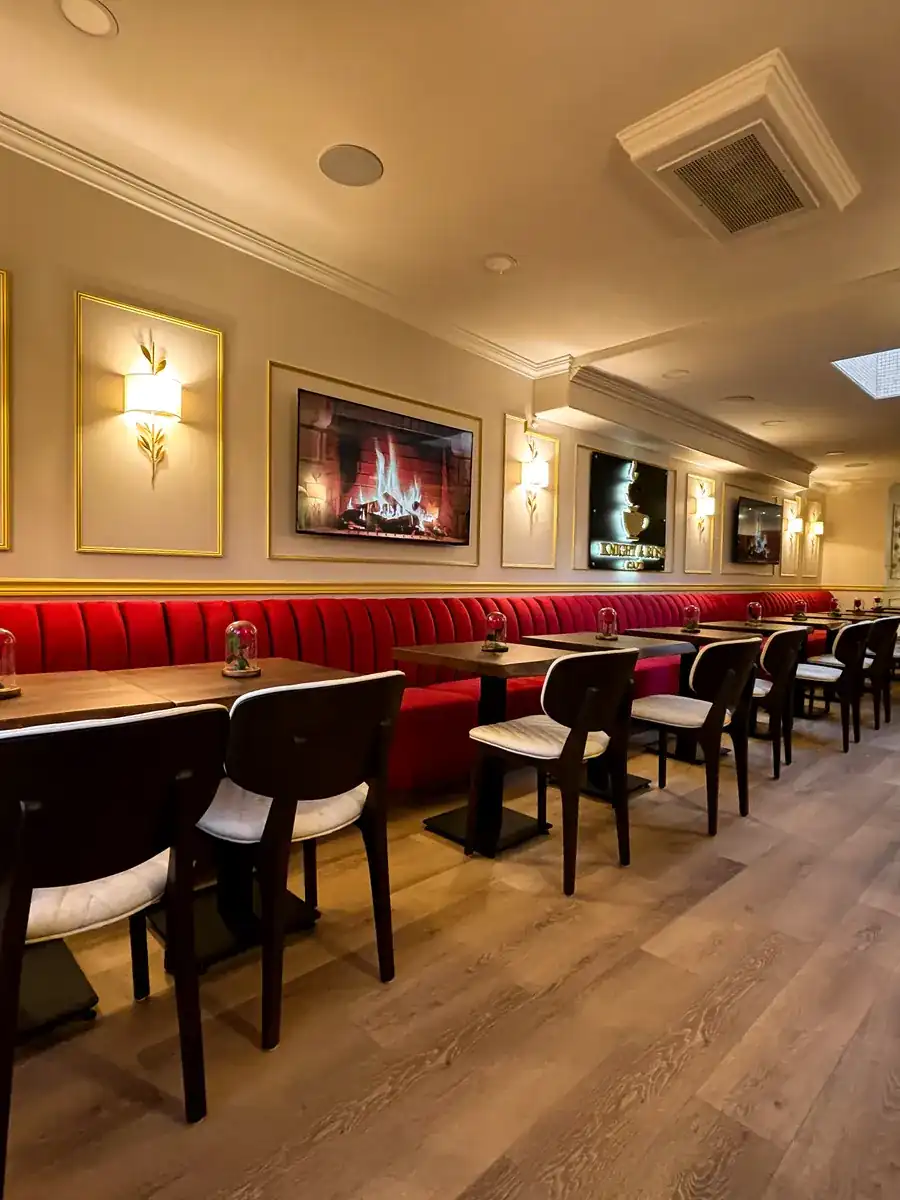
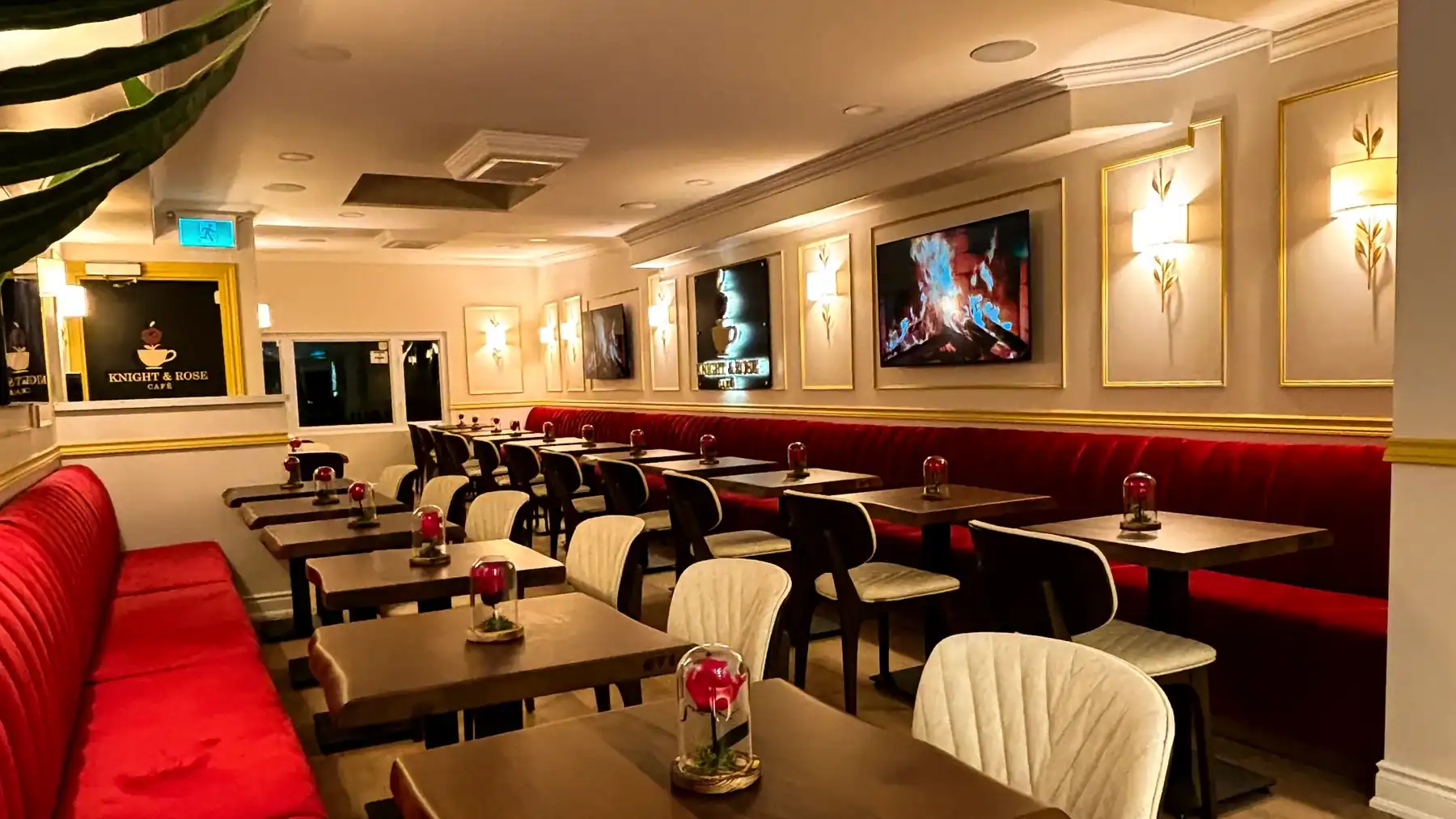
For the room itself, our bias is obvious, so here is the case rather than the pitch. Knight & Rose is on the second floor at 236 Queen Street South, which means no passing trade and no queue behind your table. The seating is red velvet banquettes and walnut, so you can stay in it. The light is brass sconces rather than overhead. We serve until midnight, and until one in the morning from Friday to Sunday, with the full menu running the whole way — so a conversation that is working does not have to end because a kitchen closed. And the river is a four-minute walk away when you want the second act.
What to order, if it helps: a Rose Silk Latte if you want the thing people remember about this place, a Blush Kashmiri Velvet if you would rather have chai, a Matcha Fusion if you want something that arrives looking like it was made on purpose. And the crème brûlée, with two spoons, ordered early.
The version that works
Meet at six on a weekday. Take a table you can stay at. Order something long. Order dessert to share before you think you want it. Ask how rather than what. Let the pauses sit. If it is going well at eight, do not move — you do not have to be anywhere, and neither do we. If it is going very well at nine, walk down to the river.
And if it is not going well, you have had a good drink in a beautiful room and you can leave at any time. That is the quiet advantage of coffee over dinner, and it is worth protecting.
Read next: reserve a table · the room after eight · the Streetsville café guide
Written by the team at Knight & Rose Café, 236 Queen Street South, Streetsville, Mississauga.